
Fabry disease in children
Fabry disease symptoms can start in late infancy and in early childhood. A child with the condition may experience only one symptom, or a range of them.
What are the symptoms of Fabry disease in children?
If a child has Classic Fabry disease, you may not notice all the signs and symptoms at first. If you have more than one child with Fabry disease, you might notice that their symptoms can differ, especially between boys and girls. Most boys tend to experience the full range of symptoms, while girls typically show a wider variety of symptoms due to the way the disease is inherited. In some cases, girls may have symptoms as severe as boys, while others may experience milder symptoms or have severe symptoms in only certain organs.1
Some early signs of Fabry disease may include:
- Emotional and social effects: depression and school absences
- Eye changes (corneal whorling): starburst pattern on the cornea (detectable during a slit lamp eye exam)
- Fever: recurrent or unexplained fevers
- Gastrointestinal: abdominal pain, diarrhea, constipation
- Hearing: tinnitus or hearing loss
- Pain: burning in hands or feet; episodic pain
- Skin lesions (angiokeratomas): clusters of small, dark red to purple skin spots
- Sweating: absent or decreased sweating
- Temperature sensitivity: intolerance to heat or cold
These symptoms, especially neuropathic pain and gastrointestinal symptoms, can start in late infancy and before early childhood, and get worse into adolescence and adulthood. Newborn screening can be used to detect Fabry disease in infants, before symptoms even begin, and is an important consideration for parents affected by the disease.1-3
Important considerationIf Fabry disease runs in your family, it’s important to consider testing your child. The earlier you confirm a Fabry disease diagnosis with testing, the sooner you can explore management options with your child’s doctor. |
Can Fabry disease be present at birth?
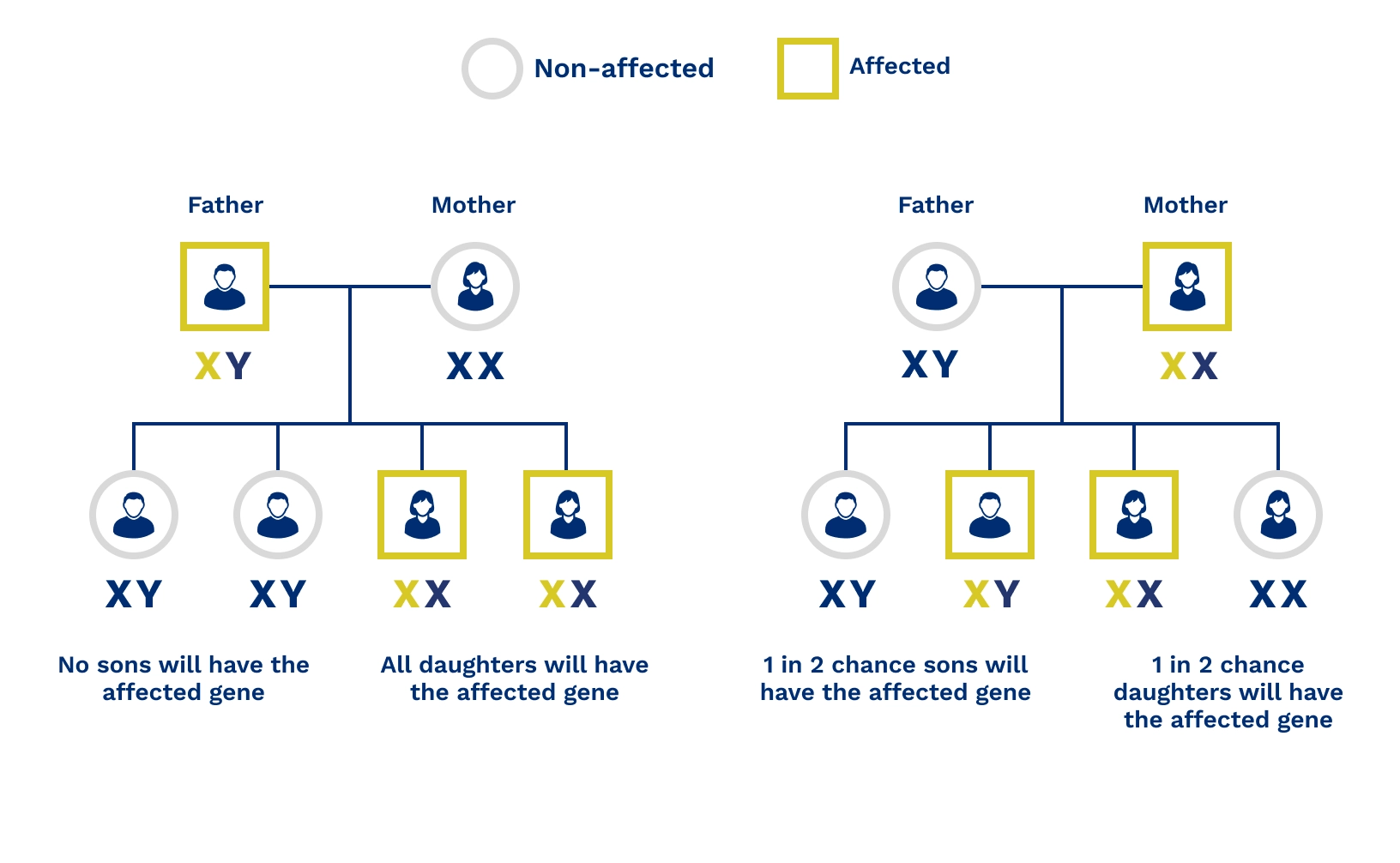
Fabry disease is a genetic condition, meaning it can be passed down in families from parent to child if one or both parents are affected by it. Fabry disease is inherited through an altered gene (GLA) on the X chromosome. Females have two X chromosomes whereas males have an X and a Y chromosome.4-7
- If a mother has Fabry disease, each of her children has a 50% chance of inheriting the GLA alteration, whether the child is born male or female.
- If a father has Fabry disease, he will always pass the GLA alteration to his daughters (because females inherit his X chromosome) but never to his sons (because males inherit his Y chromosome).
Communication expands your child’s support circle
It’s important to talk with your child’s community, especially school officials and coaches, so they can understand the impact Fabry disease may have on your child’s performance and participation in certain activities. For example, children with Fabry disease may experience bouts of unexplained fever that result in frequent school absences or missed sports practices.8
Federal and state laws ensure that students with special needs receive the support they need to succeed in school, including specific accommodations.9 The accommodations listed below are general examples and are not specific to children with Fabry disease.

Learning materials
- An extra set of textbooks for home use
- Audio recordings of lectures
- Hearing aids, adaptive keyboard, or other assistive technology

Classroom support
- A peer or aide to assist with note-taking
- Preferential seating in the classroom
- Reduced homework load or modified assignments
- Extended time for tests and assignments

Physical accommodations
- Rest breaks and flexible restroom breaks
- Permission to visit nurse, as needed
- Adaptations for gym class
- Mobility support (use of ramps, elevators, assistive devices, if needed)
- Use of fans or spray bottles for temperature sensitivity
Support for keeping your child's school informedYour Patient Education Liaison (PEL) can help your family and your child’s community (including school nurses, teachers, and coaches) understand Fabry disease through materials and in-person education upon your request. To get started, email info@CareConnectpss.com. |

Support for parents of children with Fabry disease
Caregiver support and resources
Just as your child requires consistent care and support, so do you as their caregiver. Prioritizing your own mental and physical health enables you to be a more resilient and effective advocate for your child.
At CareConnect, we’re here to support you and your child. We’re available to talk with you in person or by phone, and can provide resources to help you cope with the challenges of your child’s condition.
Talk to your PEL to find or sign up for educational opportunities.
Patient education programs
Parenting a child with a chronic illness: Join an immersive conversation on the unique experiences of parenting a child with a chronic illness and discover solutions.
Owning your care: living empowered with a rare condition: Connect with a supportive rare disease community, gain healthcare expert insights, and explore topics like how to live empowered with a rare condition, how to create true partnerships with your care team, and learn from one another’s experiences.
Talk to your PEL to find or sign up for educational opportunities.
.
Support for parents
If you want to connect with our team to learn how they can help support you and your child with Fabry disease, a Case Manager is available to speak with you Monday through Friday, 8AM-6PM ET.
Call 1-800-745-4447 (for English, press 3; para español, oprima 7) or email info@CareConnectPSS.com.

References
1 Ellaway C. Paediatric Fabry disease. . Jan 2016;5(1):37-42. doi:10.3978/j.issn.2224-4336.2015.12.02
2 Gragnaniello V, Burlina AP, Commone A, et al. Newborn Screening for Fabry Disease: Current Status of Knowledge. Int J Neonatal Screen. Jun 5 2023;9(2). doi:10.3390/ijns9020031
3 Bugescu N, Naylor PE, Hudson K, Aoki CD, Cordova MJ, Packman W. The Psychosocial Impact of Fabry Disease on Pediatric Patients. J Pediatr Genet. Sep 2016;5(3):141-9. doi:10.1055/s-0036-1584357
4 Alberts B, Johnson A, Lewis J. Molecular Biology of the Cell. 4th edition. Chromosomal DNA and Its Packaging in the Chromatin Fiber. Garland Science; 2002.
5 Laney DA, Fernhoff PM. Diagnosis of Fabry disease via analysis of family history. J Genet Couns. Feb 2008;17(1):79-83. doi:10.1007/s10897-007-9128-x
6 Germain DP. Fabry disease. Orphanet J Rare Dis. Nov 22 2010;5:30. doi:10.1186/1750-1172-5-30
7 How Is Fabry Disease Inherited? National Fabry Disease Foundation. Accessed August 10, 2025. https://www.fabrydisease.org/about-fabry-disease/fabry-disease-inheritance.
8 Burlina AP, Sims KB, Politei JM, et al. Early diagnosis of peripheral nervous system involvement in Fabry disease and treatment of neuropathic pain: the report of an expert panel. BMC Neurol. May 27 2011;11:61. doi:10.1186/1471-2377-11-61
9 Three Important Laws that Support Individuals with Disabilities. National Education Association. Accessed September 17, 2025. https://www.nea.org/professional-excellence/student-engagement/tools-tips/three-important-laws-support-individuals-disabilities.
Sanofi does not provide medical advice, diagnosis, or treatment. The health information contained herein is provided for general educational purposes only. Your healthcare professional is the best source of information regarding your health. Please consult your healthcare professional if you have any questions about your health or treatment.
MAT-US-2511950-v1.0-11/2025