
Fabry disease inheritance
Fabry disease is a rare, inherited disorder. It is caused by changes in a gene called GLA, which is found on the X-chromosome.1,2
How Fabry disease affects families
Because it’s inherited, it’s important to understand how Fabry disease can affect many members of a family. If one person has Fabry disease, other immediate and extended family members like parents, siblings, children, aunts, uncles, and cousins may also have it. If one person in a family is diagnosed with Fabry disease, on average, five other family members may be affected.3

Video: How the Hill family learned to talk about Fabry disease
"With our family, a lot of us had it, so we were able to share the ups and downs and the embarrassing aspects of the disease."Jodie, living with Fabry disease |
What are the causes of Fabry disease?
The causes of Fabry disease are linked to changes in a gene called GLA.
When working normally, GLA produces an enzyme called alpha galactosidase A, or alpha-GAL. Alpha-GAL helps break down and remove a fatty substance called GL-3 (globotriaosylceramide) from blood vessels and organs.
Alterations to GLA may cause the body to produce little or no alpha-GAL. When that happens, GL-3 can build up. Too much build up can disrupt how cells function, which can damage tissue and organs, and lead to a wide range of symptoms.1,2
How is Fabry disease inherited?
Fabry disease is an inherited genetic disorder, meaning it is passed on from parents to their children. it is also an X-linked condition, meaning the Fabry disease gene is passed on through the X chromosome.1
Understanding how Fabry disease runs in families can be an important step toward getting a timely and accurate diagnosis. It is also important because many patients living with Fabry disease may go for years with misdiagnoses and unmanaged symptoms before getting tested.3
How inheritance works
Understanding what’s known as an “inheritance pattern” can help you better understand how Fabry disease is passed down in families.4,5
Here’s how it works: Our cells have chromosomes, which are structures that carry the genetic code our bodies use to make proteins and function properly.
The X and Y chromosomes (or sex chromosomes) are what determine if a person will be male or female.
- Females have two X chromosomes. They inherit one from each parent.
- Males have one X and one Y chromosome. They inherit the X chromosome from their mother and the Y chromosome from their father.

How Fabry disease is passed on to children
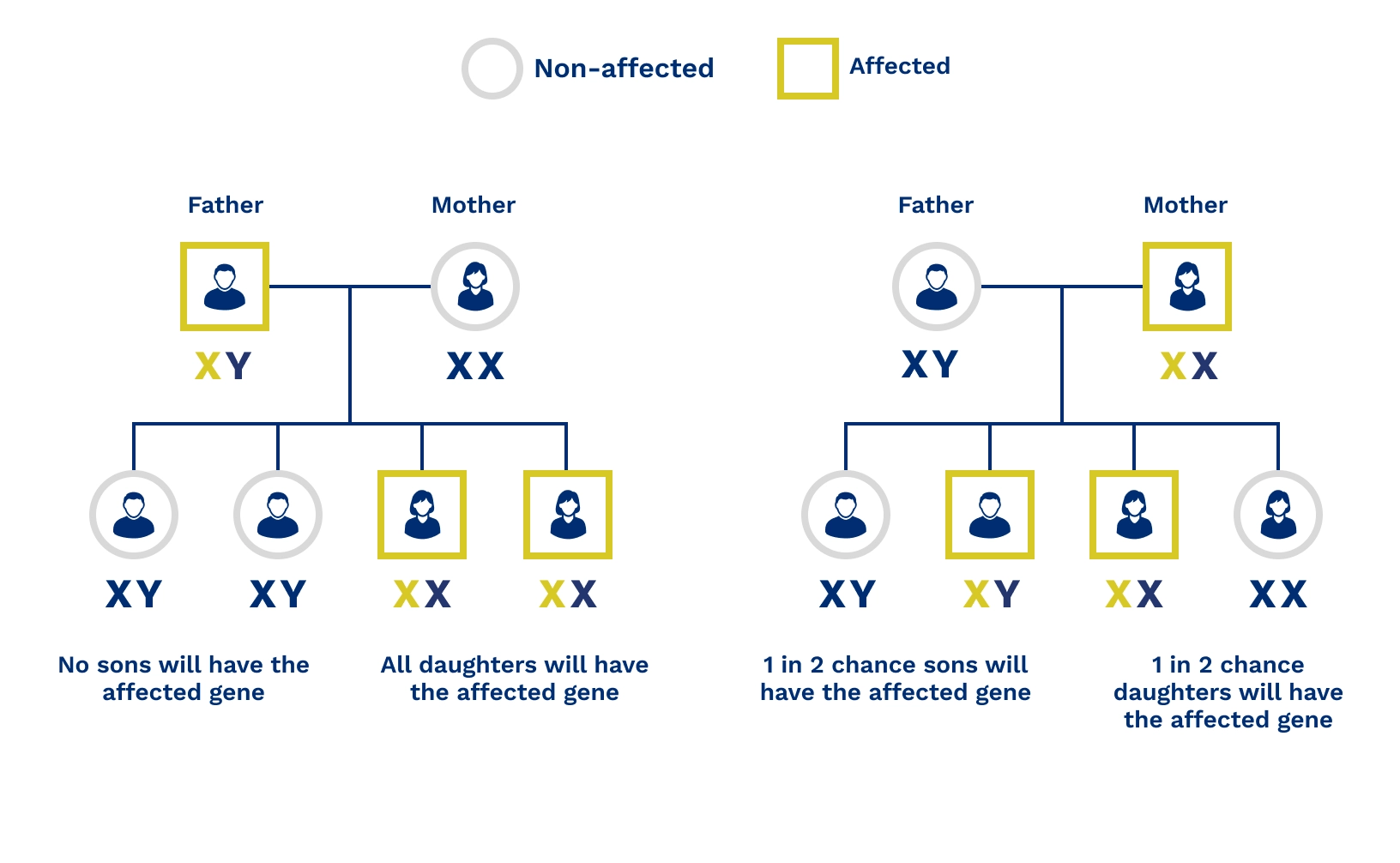
Males and females can both be affected by Fabry disease because they each have at least one X chromosome.
When a father has Fabry disease, there is a 100% chance that he will pass the affected X chromosome to a daughter, but a 0% chance he will pass it to a son.
When a mother has one X chromosome with the Fabry disease gene, there is a 50% chance she will pass it to a child, no matter if the child is a daughter or son. It is a random process, which means a mother could pass the gene to all of her children, none of them, or any number in between.
Understand your family treeThe first step to tracing Fabry disease in your family is creating a medical family tree. For more information on how you can begin mapping your family history, call 1-800-745-4447 or email info@CareConnectPSS.com to reach a Case Manager who will then connect you with your Patient Education Liaison (PEL). |
.

Video: How the Hill family learned to talk about Fabry disease
Why is it important to talk with your family about Fabry disease?
Benefits of talking to your family
It can be hard to share a Fabry disease diagnosis with others, but talking about the disease with your family is important for a few reasons.
- Your immediate and extended family members might also be affected and could benefit from testing and medical guidance.
- Learning about Fabry disease may help family members understand their previously unexplained symptoms.
The sooner family members who may have Fabry disease are diagnosed, the earlier they can explore treatment options. - Telling your family about a Fabry disease diagnosis may not be easy, so we created a sample letter that may help you approach the subject with them.
Testing for family members
Getting tested for a chronic condition like Fabry disease may cause some nervousness, but there are many benefits. Testing can relieve uncertainty, especially if the result is negative. And a positive test result can mean an earlier diagnosis, which can lead to appropriate treatment and care. Since earlier treatment may improve outcomes, it is important to get tested early if you or a family member suspect you may have the condition.6
Testing is usually done with a simple blood or saliva test. Changes in the GLA gene or levels of the alpha-GAL enzyme are used to confirm or rule out a Fabry disease diagnosis.
Support for caregivers
CareConnect offers free personalized and confidential support services for both patients with Fabry disease and those caring for them. Finding out a loved one has been diagnosed with a serious, rare medical condition is never easy and the more you know, the more confident you will feel about helping a family member with Fabry disease. Your CareConnectPSS PEL can help you map inheritance patterns, educate family members, and navigate other complex issues associated with Fabry disease.
Help for families impacted by Fabry disease
If you want to connect with our team about how Fabry disease can impact families, a Case Manager is available to speak with you Monday through Friday, 8AM-6PM ET.
Call 1-800-745-4447 (for English, press 3; para español, oprima 7) or email info@CareConnectPSS.com.

References
1 Germain DP, Moiseev S, Suarez-Obando F, et al. The benefits and challenges of family genetic testing in rare genetic diseases-lessons from Fabry disease. Mol Genet Genomic Med. May 2021;9(5):e1666. doi:10.1002/mgg3.1666
2 Bokhari SRA, Zulfiqar H, Hariz A. Fabry Disease. StatPearls. StatPearls Publishing
3 Laney DA, Fernhoff PM. Diagnosis of Fabry disease via analysis of family history. J Genet Couns. Feb 2008;17(1):79-83. doi:10.1007/s10897-007-9128-x
4 Alberts B, Johnson A, Lewis J. Molecular Biology of the Cell. 4th edition. Chromosomal DNA and Its Packaging in the Chromatin Fiber. Garland Science; 2002.
5 How Is Fabry Disease Inherited? National Fabry Disease Foundation. Accessed August 10, 2025. https://www.fabrydisease.org/about-fabry-disease/fabry-disease-inheritance.
6 van der Veen SJ, Korver S, Hirsch A, et al. Early start of enzyme replacement therapy in pediatric male patients with classical Fabry disease is associated with attenuated disease progression. Mol Genet Metab. Feb 2022;135(2):163-169. doi:10.1016/j.ymgme.2021.12.004
Sanofi does not provide medical advice, diagnosis, or treatment. The health information contained herein is provided for general educational purposes only. Your healthcare professional is the best source of information regarding your health. Please consult your healthcare professional if you have any questions about your health or treatment.
MAT-US-2511955-v1.0-11/2025