
Understanding Gaucher disease inheritance
Gaucher disease is a rare genetic disorder that runs in families, caused by changes in a gene called GBA1.1 Learning how the condition is inherited can help families understand who may be at risk.
What causes Gaucher disease?
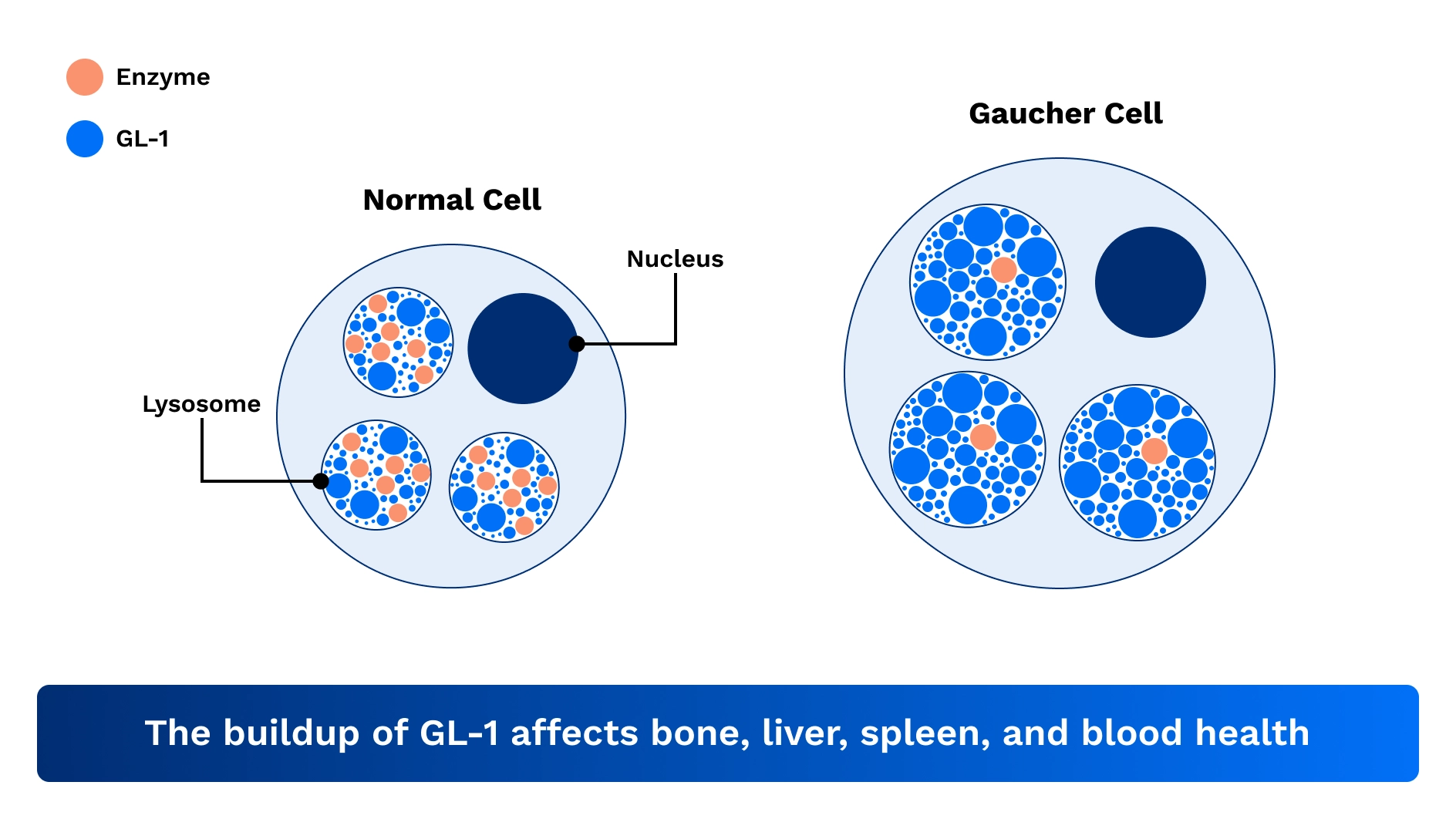
Gaucher disease is caused by genetic changes (also called pathogenic variants) in a gene called GBA1 . GBA1 produces an enzyme called glucocerebrosidase (pronounced gloo-ko-ser-e-bro-sydaze), which helps break down a fatty substance called glucosylceramide (gloo-ko-sil-sara-mide, also known as GL-1).1
People with Gaucher disease may be missing this enzyme or may lack enough of the enzyme to keep up with the amount of GL-1 that accumulates. As GL-1 builds up in certain cells, people with Gaucher disease may experience signs and symptoms in different systems throughout the body, such as the blood, bones, and organs like the spleen and liver.1
There are more than 400 possible pathogenic variants in the GBA1 gene that have been linked to Gaucher disease. Although some are associated with more severe disease types, genetics alone do not determine how severe the disease will be. Two people with the same pathogenic variants can still have very different symptoms.1,2
Because Gaucher disease is caused by changes in a specific gene, it’s important to understand how these pathogenic variants can be passed down in families.
How is Gaucher disease inherited?
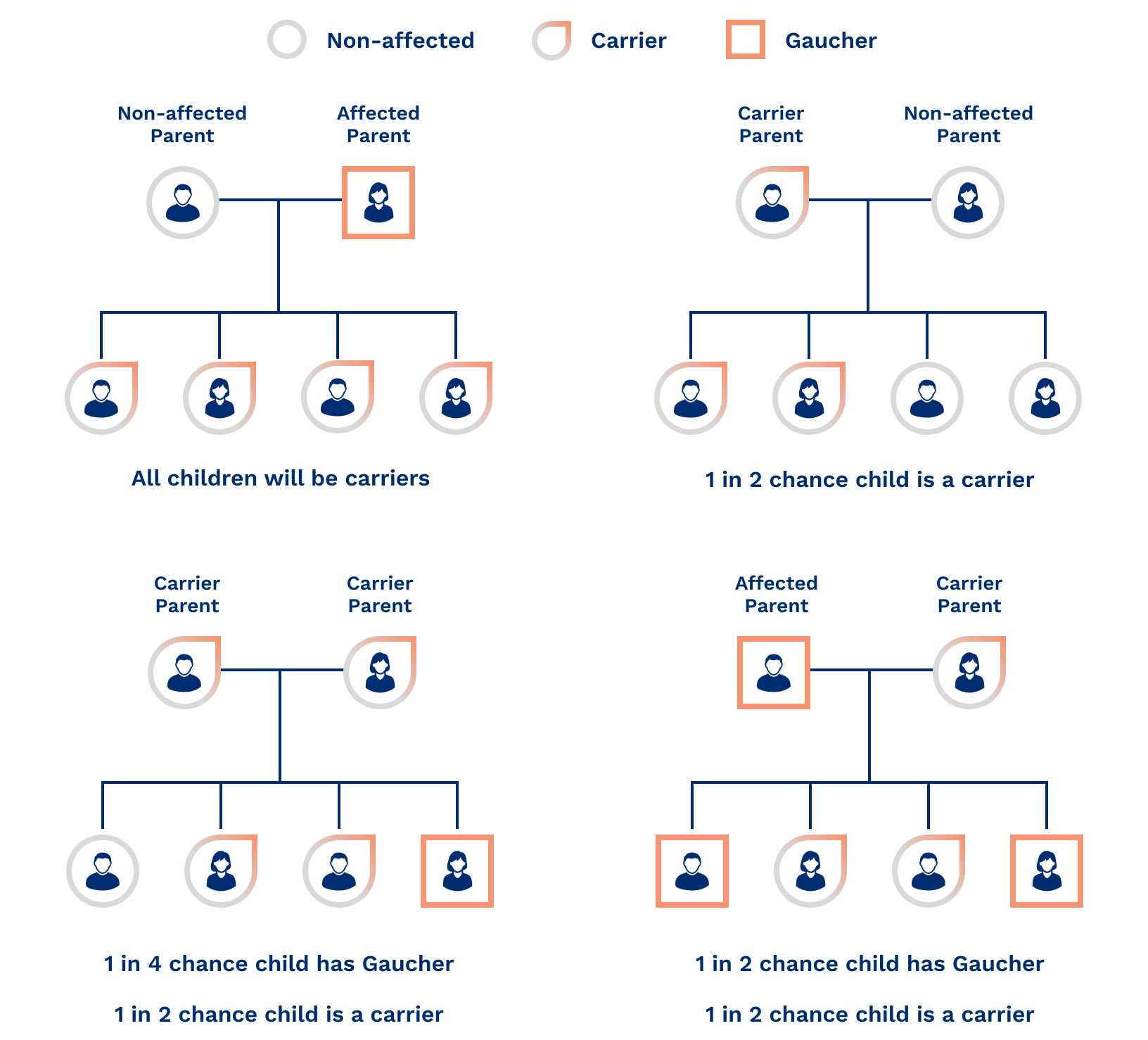
Gaucher disease is inherited in an autosomal recessive pattern. This means a child must get two altered copies of the same gene, one from each parent, to have Gaucher disease. Knowing how this works can help you understand how the condition may run in families, and who could be at risk.2
How inheritance works
Genetic conditions like Gaucher disease are caused by pathogenic variants in genes, which are part of your body’s DNA. Genes contain instructions that our cells use to make proteins and keep the body functioning properly. Most genes come in pairs, with one copy inherited from each biological parent.
- The GBA1 gene is autosomal, meaning it is not related to biological sex. Both males and females are equally likely to inherit or pass down the altered gene.
- Recessive inheritance means a person must inherit two copies of the altered gene—one from each parent—to have Gaucher disease.
- People who inherit only one altered copy are called carriers. Carriers generally do not show signs or symptoms but can pass the altered gene to their own children.
- If both parents are carriers, each child has a 1 in 4 chance of having Gaucher disease. If one parent has Gaucher disease and the other is a carrier, the chance increases to 1 in 2 for each child. Each pregnancy is an independent event, so the risk remains the same each time.2
Understanding how Gaucher disease is inherited helps explain who may develop the condition and why it may be more common in certain populations.
Who can be affected by Gaucher disease?
Gaucher disease is rare, affecting about 1 in 40,000 people. Men and women are equally affected, though the age at which symptoms appear can vary depending on the individual and disease type.1,3

Adults and children are affected by the three types of Gaucher disease
- Type 1: Most common in the United States; can be diagnosed at any age; more frequent in people of Ashkenazi Jewish ancestry.3,4
- Type 3: More common in other parts of the world; usually diagnosed in childhood.4
- Type 2: The rarest and most severe form; begins in infancy and gets worse very quickly.4
It's important to remember that regardless of age or background, anyone who inherits two copies of the altered GBA1 gene can be affected. Beyond individual risk, Gaucher disease can have wider effects on families.5,6

Gaucher disease in Ashkenazi Jewish populations
Gaucher disease is more common among people of Ashkenazi Jewish ancestry. In some communities, carrier rates may be as high as 1 in 10, which increases the likelihood that two carriers could have a child with Gaucher disease.7
Because of this higher carrier rate, screening and genetic counseling are strongly recommended for people of Ashkenazi Jewish descent who are planning a family.8
The Our Heritage, Our Health Jewish Community Patient Brochure offers more information about Gaucher disease inheritance in Jewish communities.
.
The importance of genetic screeningBecause the likelihood of having an affected child depends on the parents’ genetic status, consider getting screened if you are planning a family and have concerns about Gaucher disease. You may be a carrier even if you have no symptoms.5 A Patient Education Liaison (PEL) can help with screening guidance and understanding the chances of having an affected child.
A Case Manager is available to speak with you Monday through Friday, 8AM-6PM EST, and can connect you with your PEL. Call 1-800-745-4447 (for English, press 3; para español, oprima 7) or email info@CareConnectPSS.com. |

How can Gaucher disease impact families?
Gaucher disease can affect more than just the person receiving the diagnosis. Because it can be passed down, other family members may also be affected and should consider testing. Symptoms and severity can vary from one person to the next, even within the same family.1
Families impacted by Gaucher disease may experience challenges6 such as:
- Frustration from delayed diagnoses
- Uncertainty around their symptoms
- Emotional strain from caregiving
Resources are available to help families cope with these challenges.
Because inheritance plays such a key role, open conversations with relatives can help them understand their own health risks and make informed decisions.
Gaucher disease in children
Gaucher disease is a lifelong condition and for some children who inherit the disease, symptoms can begin while they are still young. Some of the first symptoms you or your child may notice include:
- Swollen abdomen (from enlarged spleen/liver)
- Bleeding issues
- Neurologic issues like developmental delays or poor coordination (for type 2 or 3 disease)
Many pediatricians are not familiar with Gaucher disease and may not be able to spot the signs, so it’s important to proactively ask about testing if your child could be at risk or if they show any symptoms.9,10
How can I talk with my family about Gaucher disease?
Talking about a Gaucher disease diagnosis with others can be difficult, but sharing this information with your family allows relatives to:
- Share medical history
- Coordinate genetic counseling
- Make informed decisions
Some relatives may have unexplained symptoms or are not aware they could be carriers. Since earlier diagnosis and treatment can improve outcomes,11 it’s important for affected family members to get tested early and begin appropriate disease management as soon as possible.

Support and resources for you and your family
Enrolling in CareConnect gives you access to important educational programs. They can be attended virtually or in person, and are led by experts in the field.
Patient education programs
- Communicating with Family about Health Information: Learn how to navigate family conversation about lysosomal storage disorders and how they can be inherited.
- Foundations of Family Tree: Understand the inheritance of a lysosomal storage disorder and how to complete a medical family tree.
- Our Heritage, Our Health: Explore genetic disease prevalent in Ashkenazi Jewish communities, focusing on Gaucher disease, inheritance patterns, and available screening or testing.
Talk to your PEL (Patient Education Liaison) to find or sign up for education opportunities or learn more about the CareConnect services and team.
Help for families impacted by Gaucher disease
If you want to understand what other resources are available for families impacted by Gaucher disease, a Case Manager is available to speak with you Monday through Friday, 8AM-6PM ET.
Call 1-800-745-4447 (for English, press 3; para español, oprima 7) or email info@CareConnectPSS.com.

References
1 Stone WL, Basit H, Mukkamalla SKR, Master SR. Gaucher Disease. StatPearls. 2025.
2 Gaucher Disease Inheritance and Genetics. National Gaucher Foundation. Accessed September 30, 2025. https://www.gaucherdisease.org/about-gaucher-disease/genetics/.
3 Stirnemann J, Belmatoug N, Camou F, et al. A Review of Gaucher Disease Pathophysiology, Clinical Presentation and Treatments. Int J Mol Sci. Feb 17 2017;18(2). doi:10.3390/ijms18020441
4 Schiffmann R, Sevigny J, Rolfs A, et al. The definition of neuronopathic Gaucher disease. J Inherit Metab Dis. Sep 2020;43(5):1056-1059. doi:10.1002/jimd.12235
5 Hughes DA, Pastores GM. Gaucher Disease. In: Adam MP, Feldman J, Mirzaa GM, Pagon RA, Wallace SE, Amemiya A, eds. GeneReviews® [Internet]. University of Washington, Seattle; 1993-2025.
6 Psychosocial Impacts of Living with Gaucher Disease. National Gaucher Foundation - NGF Blog. Accessed September 30, 2025. https://www.gaucherdisease.org/blog/psychosocial-impacts-living-gaucher-disease/.
7 Gaucher Disease Carrier Status. National Gaucher Foundation. Accessed September 30, 2025. https://www.gaucherdisease.org/gaucher-diagnosis-treatment/testing/carrier/.
8 Gross SJ, Pletcher BA, Monaghan KG, Professional P, Guidelines C. Carrier screening in individuals of Ashkenazi Jewish descent. Genet Med. Jan 2008;10(1):54-6. doi:10.1097/GIM.0b013e31815f247c
9 Young Children. National Gaucher Foundation. Accessed October 5, 2025. https://www.gaucherdisease.org/living-with-gaucher-disease/optimal-health/young-children/.
10 Understanding the Neurological Symptoms of Gaucher Disease. National Gaucher Foundation Blog. Accessed October 2, 2025. https://www.gaucherdisease.org/blog/neurological-symptoms-of-gaucher-disease/.
11 Mendez-Cobian DA, Guzman-Silahua S, Garcia-Hernandez D, et al. An Overview of Gaucher Disease. Diagnostics (Basel). 2024;14(24). doi:10.3390/diagnostics14242840
MAT-US-2511960-v1.0-12/2025