

What is Gaucher disease?
Who does Gaucher disease affect?
Gaucher (pronounced go-SHAY) disease is a rare, lysosomal storage disorder that affects about 1 in 40,000 people. It can affect males and females of all ages. All types of Gaucher disease can be found in people of any ethnicity, though type 1 occurs more frequently among the Ashkenazi Jewish population, with an estimated incidence rate of 1 in 800.1,2 The Our Heritage, Our Health Jewish Community Patient Brochure can teach you more.
Symptoms of Gaucher disease can be different for each person and may range from mild to severe. Gaucher disease is a lifelong condition that can get worse over time, and is also often misdiagnosed or undetected. This can cause treatment delays, which can lead to permanent damage to bones and major organs. The earlier Gaucher disease is diagnosed, the sooner it can be managed properly.1,2
What causes Gaucher disease?
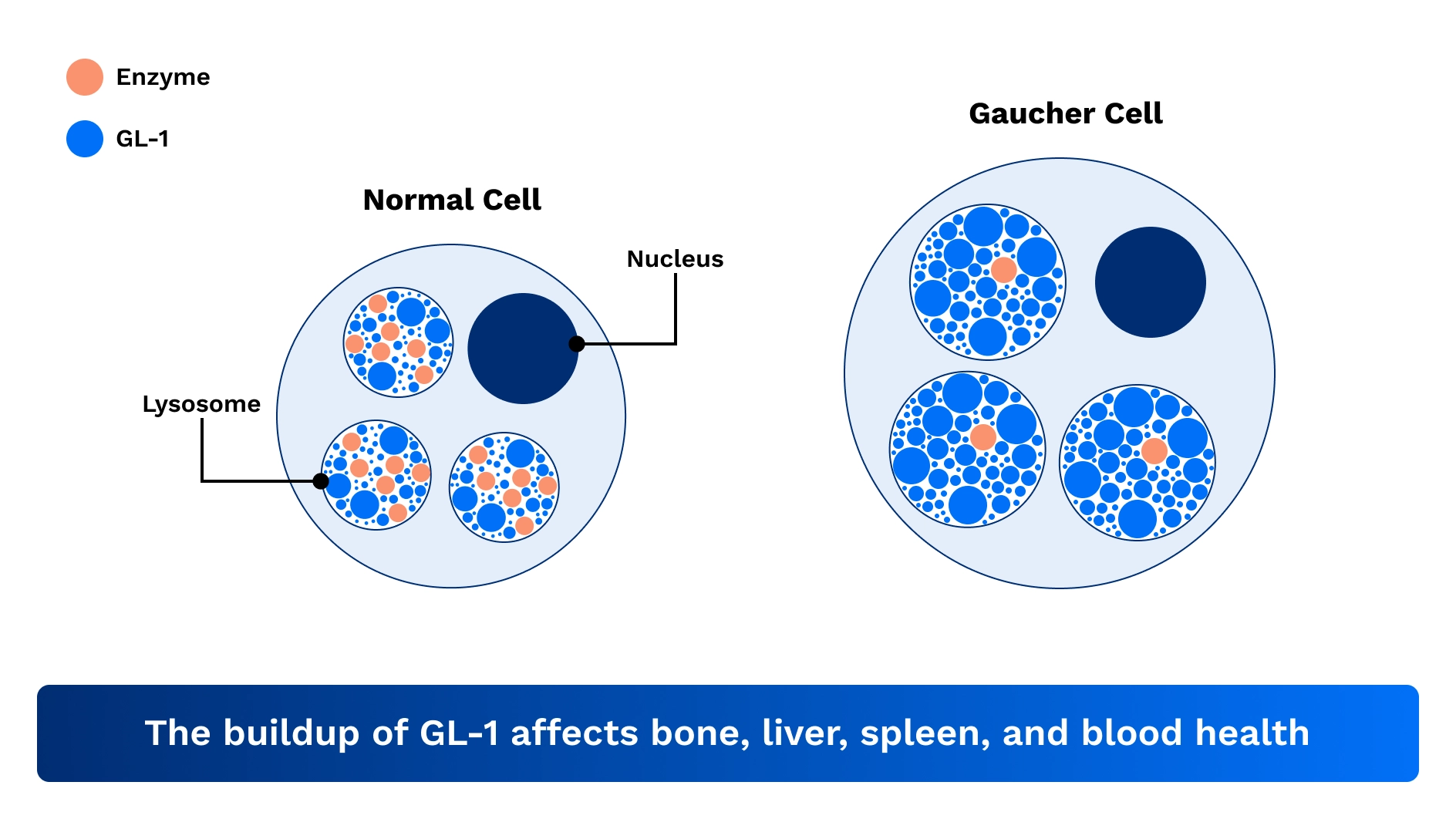
Gaucher disease is an inherited genetic condition that causes a lipid, called glucosylceramide (gloo-ko-sil-sara-mide, also known as GL-1), to build up in various tissues including the liver, spleen, and bone marrow.1,2
Typically, an enzyme called glucocerebrosidase (pronounced gloo-ko-ser-e-bro-sydaze) breaks down GL-1. People with Gaucher disease may be missing this enzyme or may lack enough of the enzyme to keep up with the amount of GL-1 that accumulates.
As GL-1 builds up in certain cells, people with Gaucher disease may experience signs and symptoms in different systems throughout the body, such as the blood, bones, and organs like the spleen and liver. In particular, patients may experience swelling of the spleen and/or liver, possibly resulting in a protruding abdomen, as well as increased bruising and bleeding.1,2
Types of Gaucher disease
Gaucher disease has a range of symptoms, and its severity is grouped into three main types. These types differ in which parts of the body are affected, when symptoms begin, and how quickly they change over time.2,3
Type 1
Type 1 is also known as “non-neuronopathic” Gaucher disease.
- Most common type in the United States
- Does not usually affect the central nervous system (brain and spinal cord)
- Symptoms can start at any age and may range from mild to severe
- Can often limit quality of life and is often associated with considerable morbidity, but is rarely life threatening
Type 3
Type 3 is also known as “chronic neuronopathic” Gaucher disease.
- Less common in the United States, but more common worldwide
- Affects the central nervous system (causes neurologic symptoms)
- Neurologic symptoms usually start during childhood, and can worsen more slowly than type 2
- Many people with type 3 disease can reach adulthood with appropriate disease management
Type 2
Type 2 is also known as “acute neuronopathic” Gaucher disease.
- Rarest of the three types
- Affects the central nervous system (causes neurologic symptoms)
- Neurologic symptoms start during infancy and tend to be severe
- Disease gets worse very quickly and can lead to death before 4 years of age
What are the symptoms of Gaucher disease?
Gaucher disease symptoms can vary widely from person to person. Which parts of the body are affected, the age when symptoms start, and how quickly they can get worse over time all differ depending on the type of Gaucher disease and the individual.1-3
Some Gaucher disease symptoms include:
- Bone pain
- Fatigue
- Bruising easily
- Frequent nosebleeds
- Enlarged belly or abdomen
- Nervous system/movement disorders (for types 2 and 3)
All possible symptoms of Gaucher disease should be taken seriously. If you have concerns about any symptoms, be sure to contact your doctor.

How is Gaucher disease diagnosed?
Because Gaucher disease is rare and symptoms can be very different, patients are often misdiagnosed or get the correct diagnosis late. A doctor may suspect Gaucher disease based on certain signs and symptoms, especially if there is a family history of the disease. To confirm a Gaucher disease diagnosis a blood test is done to check for changes in the GBA1 gene or low levels of the glucocerebrosidase enzyme.1,2
The importance of early detectionIt’s important to contact your doctor to discuss testing options if you think you or a family member might have Gaucher disease. Early diagnosis and treatment can significantly improve outcomes for people with Gaucher disease.4 The sooner a diagnosis is confirmed, the sooner appropriate management can start. |
How is Gaucher disease managed?
Managing Gaucher disease depends on the disease type and severity. The main goals of treatment are to reduce or relieve symptoms, prevent permanent damage, and improve the patient’s overall health and quality of life.2,5 Your doctor can discuss what specific treatment options are best for you.
Find helpful resources and support for Gaucher disease
Additional support and resources are available for patients with Gaucher disease and their caregivers. For additional information about personalized support, contact our CareConnect team.
Call 1-800-745-4447 (for English, press 3; para español, oprima 7) or email info@CareConnectPSS.com.

References
1 Stone WL, Basit H, Mukkamalla SKR, Master SR. Gaucher Disease. StatPearls. 2025.
2 Stirnemann J, Belmatoug N, Camou F, et al. A Review of Gaucher Disease Pathophysiology, Clinical Presentation and Treatments. Int J Mol Sci. Feb 17 2017;18(2). doi:10.3390/ijms18020441
3 Schiffmann R, Sevigny J, Rolfs A, et al. The definition of neuronopathic Gaucher disease. J Inherit Metab Dis. Sep 2020;43(5):1056-1059. doi:10.1002/jimd.12235
4 Weinreb NJ, Aggio MC, Andersson HC, et al. Gaucher disease type 1: revised recommendations on evaluations and monitoring for adult patients. Semin Hematol. Oct 2004;41(4 Suppl 5):15-22. doi:10.1053/j.seminhematol.2004.07.010
5 Pastores GM, Weinreb NJ, Aerts H, et al. Therapeutic goals in the treatment of Gaucher disease. Semin Hematol. Oct 2004;41(4 Suppl 5):4-14. doi:10.1053/j.seminhematol.2004.07.009
MAT-US-2511957-v1.0-12/2025