

What is Fabry disease?
About Fabry disease
Classic Fabry disease, also known as Anderson-Fabry disease, is a rare lysosomal storage disorder that affects roughly 1 in 40,000 males, and 1 in 20,000 females. Fabry disease is chronic and progressive, which means it stays with you for life and may get worse over time.1-3
Fabry disease can be hard to diagnose because its symptoms can often look different from person to person. Early treatment and management of the disease may lead to to improved outcomes, so it’s important to find a doctor with a good understanding of the disease.4-6
Fabry disease is inherited, which means it can be passed down in families. If you think you or a family member may have Fabry disease, talk to a doctor as soon as possible about getting tested. If you or someone in your family is diagnosed, it's important to share that information so other family members can consider getting tested and make informed decisions about their health.6,7
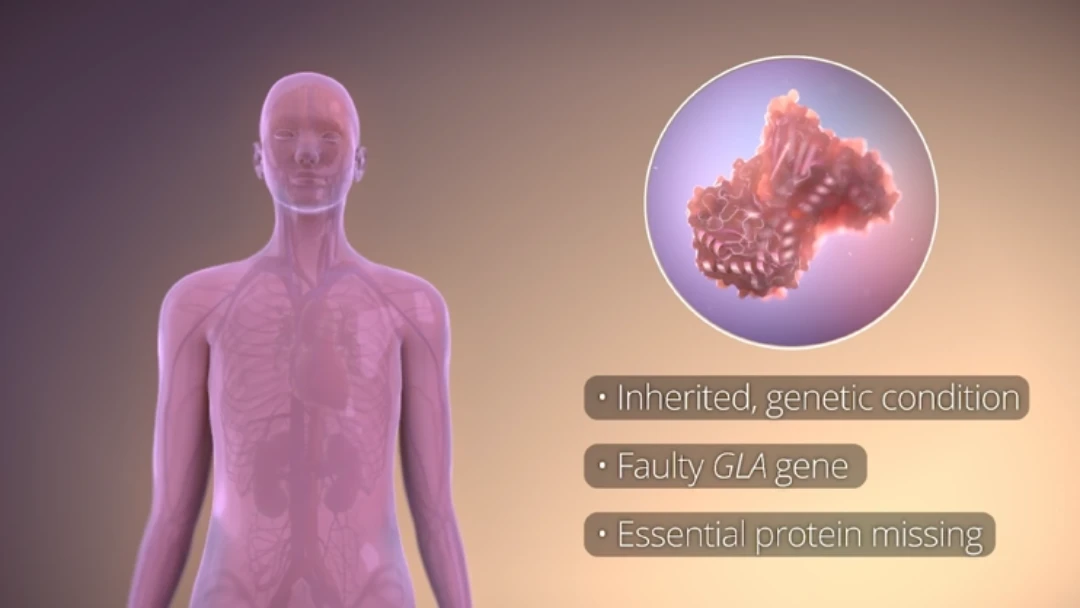
Video: Understand the basics of Fabry disease
What causes Fabry disease?
Fabry disease is a genetic disorder caused by alterations to the GLA gene.4 This gene is important because it produces an enzyme called alpha-galactosidase A, or alpha-GAL, which helps remove a fatty substance called globotriaosylceramide (GL-3) from blood vessels and organs.6,8
In Fabry disease, changes to the GLA gene can sometimes cause the body to make less alpha-GAL, and that can lead to a buildup of GL-3. Over time, this buildup can damage blood vessels and keep organs like the kidneys, heart, and brain from getting the blood they need to work properly.6,8
Who does Fabry disease affect?
Fabry disease can impact individuals of any gender, race, background, or age. Classic Fabry disease begins in childhood and it tends to worsen in adults. Previously, it was believed that only males could develop the disease and females could be only carriers who remained asymptomatic. However, we now understand that both males and females can experience the disease, although their symptoms may differ.6

Fabry disease in males
Males with Fabry disease generally experience the full range of symptoms associated with the disease. Symptoms also tend to be more severe and present at earlier ages than they do in females.9

Fabry disease in females
Females with Fabry disease experience a more varied presentation of symptoms due to how the disease is inherited. Symptoms in females can range from mild or asymptomatic to more severe in certain organs and not in others. Females with Fabry disease may develop symptoms over time, and those who are symptomatic may develop brain, heart, or kidney abnormalities later in life.9
Impact on lifespan
At-risk biological males and biological females should get tested for Fabry disease. If the disease is not detected and managed, it can seriously affect a person's health, including shortening lifespan.3,4,6 If you are diagnosed, let your family know so they can take steps to protect their health as well.
What are the symptoms of Fabry disease?
Fabry disease symptoms can be very different from person to person. Some people may have only one symptom, while others may have many. Symptoms may be mild or more severe, and can also change as time goes on. In some people, Fabry disease can lead to potentially serious or life-threatening complications like: kidney failure, cardiovascular disease, heart failure, or heart attack, stroke or ministroke (transient ischemic attack).6 These are not all of the possible symptoms of Fabry disease.
Keep an eye on your symptomsSome people don’t know they have Fabry disease until they have a serious or life-threatening health problem caused by it.2,6 Understanding the signs and symptoms of Fabry disease can help you recognize the disease early on and may prevent a delay in getting care. |
How is Fabry disease diagnosed?
Fabry disease is typically diagnosed with a simple test, using a blood or saliva sample. Alpha-GAL enzyme levels can be tested with a blood sample. Alterations in the GLA gene can be tested with either blood or saliva samples. Males can be diagnosed with enzyme. Females require DNA testing for diagnosis.6
The earlier Fabry disease is recognized, the sooner monitoring and management can begin, which can lead to better outcomes for the patient.5 In many cases, doctors don’t test for Fabry disease until after the onset of serious conditions, like organ damage or a stroke.2 Since Fabry disease can run in families, you may want to communicate your diagnosis to your family members and encourage them to get tested too.
Although most people are diagnosed in adulthood, symptoms can begin in childhood.6 Testing can find Fabry disease early—even before symptoms show—and help prevent delays in getting care. If the disease runs in your family, it’s a good idea to get tested, even if you are not experiencing symptoms.
Learn about diagnostic testing
Learn about Fabry disease – connect with your CareConnect team
If you want to connect with our team, a Case Manager is available to speak with you Monday through Friday, 8AM-6PM ET.
Call 1-800-745-4447 (for English, press 3; para español, oprima 7) or email info@CareConnectPSS.com.

References
1 Bashorum L, McCaughey G, Evans O, Humphries AC, Perry R, MacCulloch A. Burden associated with Fabry disease and its treatment in 12-15 year olds: results from a European survey. Orphanet J Rare Dis. Jul 15 2022;17(1):266. doi:10.1186/s13023-022-02417-3
2 Bokhari SRA, Zulfiqar H, Hariz A. Fabry Disease. StatPearls. StatPearls Publishing Copyright © 2025, StatPearls Publishing LLC.; 2025.
3 Waldek S, Patel MR, Banikazemi M, Lemay R, Lee P. Life expectancy and cause of death in males and females with Fabry disease: findings from the Fabry Registry. Genet Med. Nov 2009;11(11):790-6. doi:10.1097/GIM.0b013e3181bb05bb
4 Fabry Disease: Perspectives from 5 Years of FOS. Oxford PharmaGenesis; 2006.
5 van der Veen SJ, Korver S, Hirsch A, et al. Early start of enzyme replacement therapy in pediatric male patients with classical Fabry disease is associated with attenuated disease progression. Mol Genet Metab. Feb 2022;135(2):163-169. doi:10.1016/j.ymgme.2021.12.004
6 Germain DP. Fabry disease. Orphanet J Rare Dis. Nov 22 2010;5:30. doi:10.1186/1750-1172-5-30
7 Laney DA, Fernhoff PM. Diagnosis of Fabry disease via analysis of family history. J Genet Couns. Feb 2008;17(1):79-83. doi:10.1007/s10897-007-9128-x
8 Amodio F, Caiazza M, Monda E, et al. An Overview of Molecular Mechanisms in Fabry Disease. Biomolecules. Oct 12 2022;12(10)doi:10.3390/biom12101460
9 Mehta A, Hughes DA. Fabry Disease. GeneReviews® [Internet]. 1993-2025.
Sanofi does not provide medical advice, diagnosis, or treatment. The health information contained herein is provided for general educational purposes only. Your healthcare professional is the best source of information regarding your health. Please consult your healthcare professional if you have any questions about your health or treatment.
MAT-US-2511951-v1.0-11/2025