
ASMD disease education
Acid sphingomyelinase deficiency (ASMD) is a rare, inherited genetic condition that can be passed down in families. ASMD is lifelong and progressive, which means it can get worse over time. Because symptoms can be hard to notice or may look like other conditions, it is sometimes misdiagnosed. The sooner ASMD is properly diagnosed, the sooner it can be managed.1
Who does ASMD affect?
ASMD can affect males and females of all ages. ASMD affects up to an estimated 1 in every 250,000 individuals.
All types of ASMD can be found in people of any ethnicity, though type A occurs more frequently among the Ashkenazi Jewish population, with an estimated prevalence of 1 in 40,000.2

What are the different types of ASMD?
Although ASMD can present with a wide variety of symptoms that vary from one person to the next, it is generally classified into three types of increasing severity: type B, type A/B, and type A. These types are defined based on whether the brain and spinal cord (also known as the central nervous system [CNS]) is affected, symptom severity, and age at onset.1,3
Type B (most common)
(No/mild CNS manifestations)
- Neurologic symptom severity: None to mild
- First appearance of symptoms: Infancy to adulthood
- What it affects: Key organs, little to no impact on the CNS
- Worsening over time: Slow
Type A/B
(Variable CNS manifestations)
- Neurologic symptom severity: Variable
- First appearance of symptoms: Infancy to childhood
- What it affects: CNS and key organs
- Worsening over time: Variable – can be slow to moderate
Type A
(Severe CNS manifestations)
- Neurologic symptom severity: Severe
- Symptom onset: Early infancy
- What it affects: CNS and key organs
- Worsening over time: Rapid
This is not a complete list of all ASMD symptoms. Only a doctor can diagnose ASMD. If you or a family member have concerns about any of these symptoms, be sure to contact your doctor.
What causes ASMD?
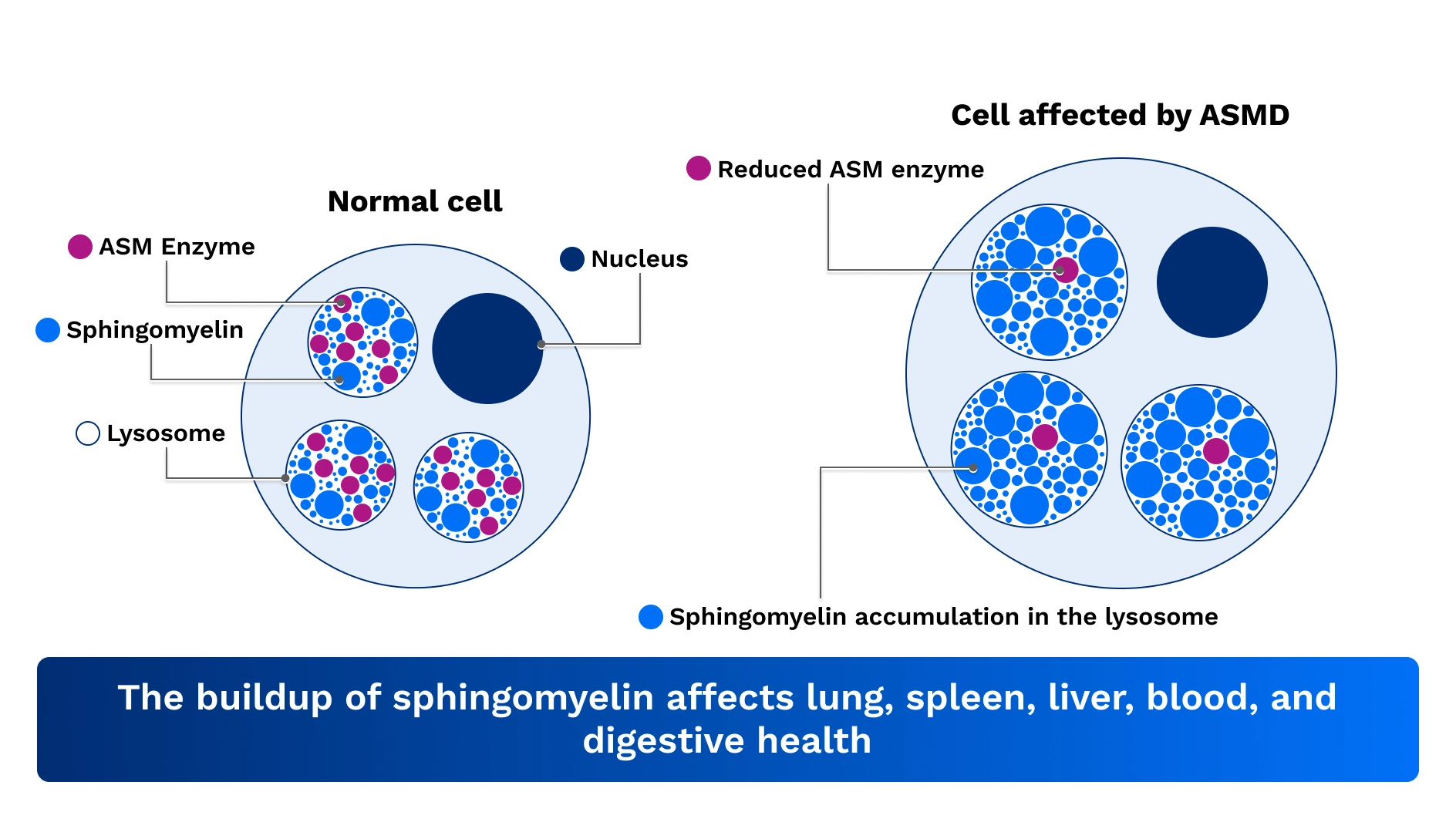
ASMD is an inherited condition caused by changes (also called pathogenic variants) in a gene called SMPD1. The SMPD1 gene produces an enzyme called acid sphingomyelinase (sfin-goh-my-uh-lin-ase), or ASM.
Enzymes are responsible for carrying out important processes in your body, such as breaking down fats and other substances in your cells.
Changes in the SMPD1 gene can prevent it from working properly, and result in the body being unable to make enough ASM. ASM is needed to break down a fatty substance called sphingomyelin (sfin-goh-my-uh-lin). This breakdown happens inside structures called lysosomes. Without enough ASM, sphingomyelin builds up in major organs such as the liver, lungs, and spleen.
This buildup can lead to signs and symptoms of the condition, including damage to affected organs, and for some types of ASMD, the brain.1,2
How is ASMD inherited?
Genetic conditions like ASMD are caused by alterations in genes called pathogenic variants. Genes contain instructions that our cells use to make proteins and keep the body functioning properly. Most genes come in pairs—one copy is inherited from each biological parent. ASMD is inherited in an autosomal recessive pattern. Understanding how this type of pattern works can help families impacted by ASMD understand who could be at risk.2
The ASMD inheritance pattern
- The SMPD1 gene is autosomal, which means it is not linked to biological sex. Males and females have an equal chance of inheriting or passing on the gene.
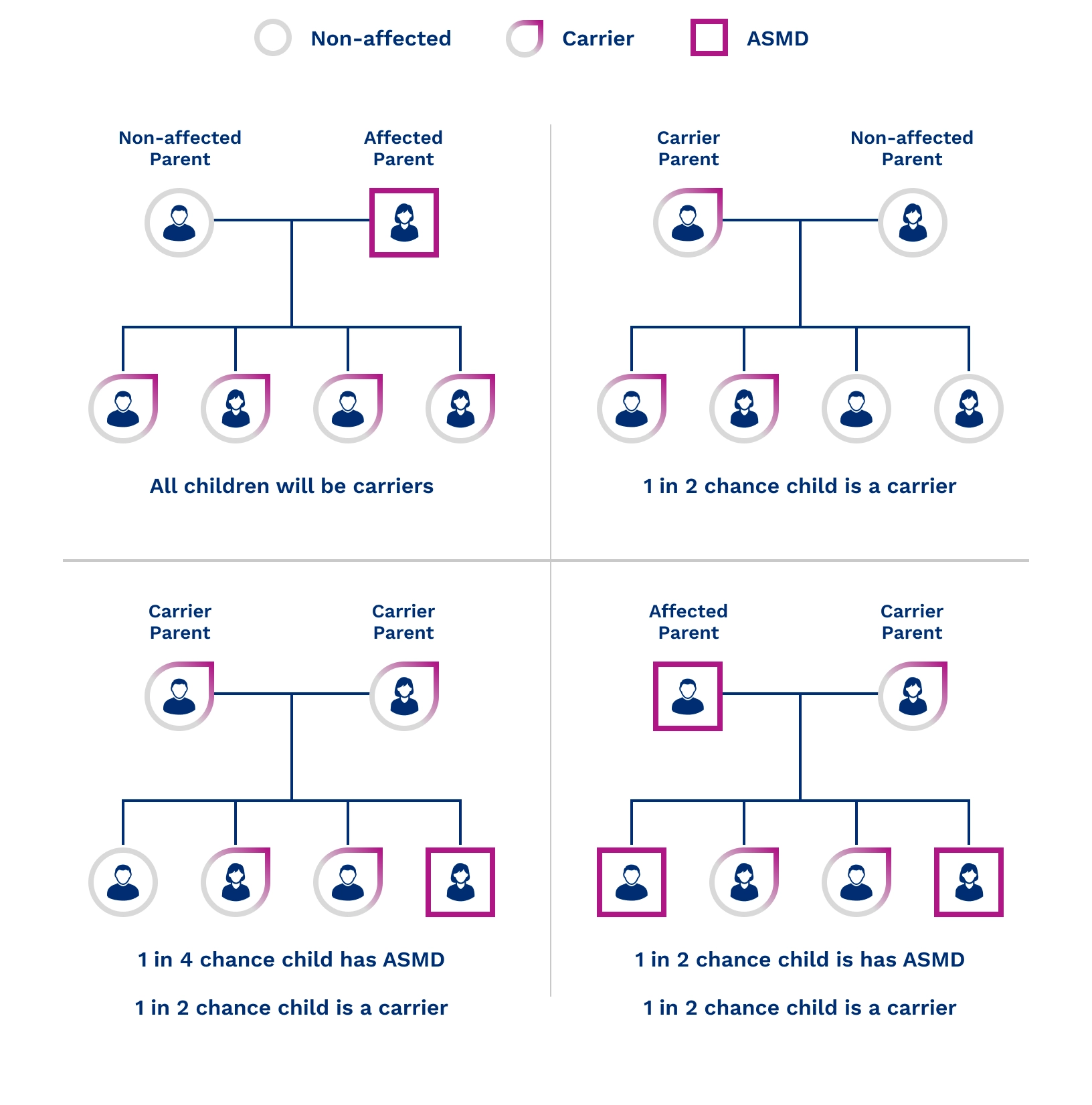
- Recessive inheritance means a person must inherit two altered copies of the SMPD1 gene, one from each parent, in order to have the condition.
- A person with only one altered SMPD1 gene is called a carrier. ASMD carriers do not have the condition and usually have no symptoms.
- If both parents are carriers, each child has a 1 in 4 chance of having ASMD and a 1 in 2 chance of being a carrier. If one parent has ASMD and the other is a carrier, the chance of having a child with ASMD increases to 1 in 2. Each pregnancy is an independent event, so the risk remains the same each time.2
Additional ASMD disease education
If you want to understand more about ASMD, or what other resources are available for individuals and families who are impacted by ASMD, our CareConnect team is available to speak with you Monday through Friday, 8AM-6PM ET.
Call 1-800-745-4447 (for English, press 3; para español, oprima 7) or email info@CareConnectPSS.com.

References
1 Geberhiwot T, Wasserstein M, Wanninayake S, et al. Consensus clinical management guidelines for acid sphingomyelinase deficiency (Niemann-Pick disease types A, B and A/B). Orphanet J Rare Dis. Apr 17 2023;18(1):85. doi:10.1186/s13023-023-02686-6
2 Bajwa H, Azhar W. Niemann-Pick Disease. StatPearls. 2025.
3 McGovern MM, Dionisi-Vici C, Giugliani R, et al. Consensus recommendation for a diagnostic guideline for acid sphingomyelinase deficiency. Genet Med. Sep 2017;19(9):967-974. doi:10.1038/gim.2017.7
MAT-US-2602113-v1.0-03/2026